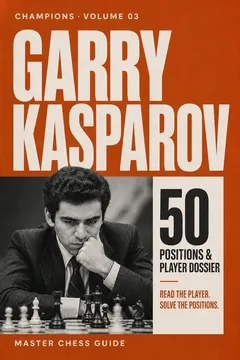
Learn how 18 world champions chose a move. Then choose 50 yourself.
For players who know their openings and their tactics and still don't know what to do on move 15. The guide gives you the question each champion asked. The workbook gives you fifty real positions and no hints.
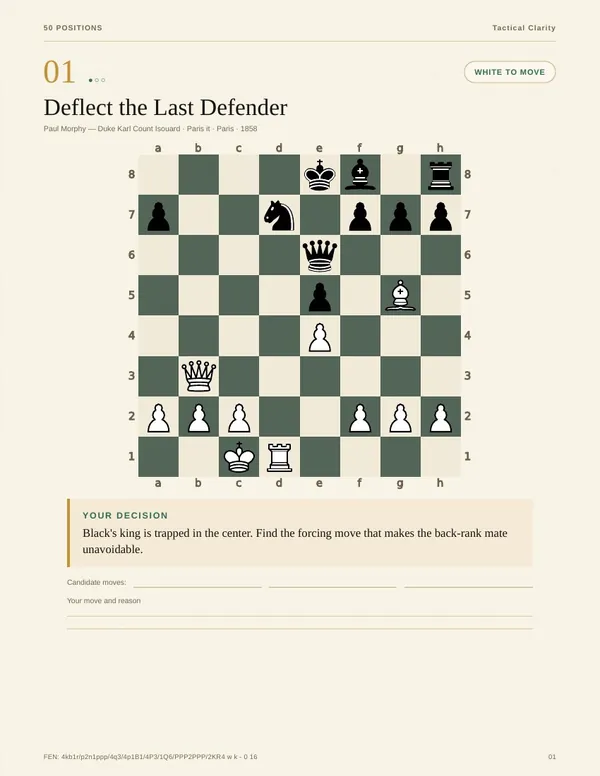
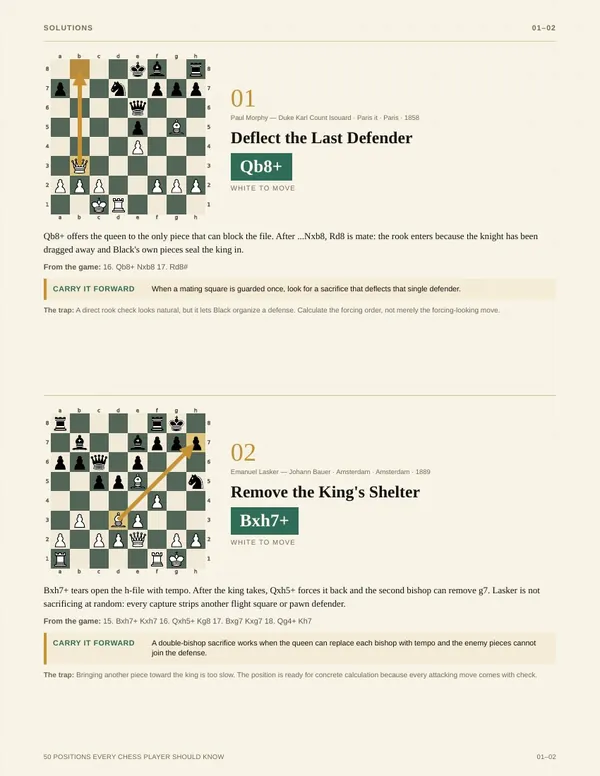
Position 1 of 50Morphy vs. Duke Karl & Count Isouard · Paris, 1858
White to move. Morphy ended the game from here. Tap a piece, then a square.
16.Qb8+ Nxb8 17.Rd8#. The knight on d7 was the only thing guarding the back rank, so Morphy gave up his queen to pull it away. The pattern to keep: find the last defender, then remove it.
Your training tells you what to look for. Your games don't.
Almost everything you study hands you the answer to the hardest question before you start: what kind of position is this?
Then you sit down to play. Around move 12 your preparation ends, the position goes quiet, and you're choosing between four reasonable moves with no idea which one matters. So you pick one and hope.
The champions didn't hope. Each of them had a question they kept asking until the position answered. You can learn those questions, and you can practice asking them when nobody has told you what you're looking at.
An opening course
“You're in this line. Here's the plan.”
A puzzle
“There's a tactic. Find it.”
An endgame chapter
“This is a rook ending.”
Your game, move 15
Nothing. Four reasonable moves and a clock.
Book I · The guide
Eighteen champions. One question each.
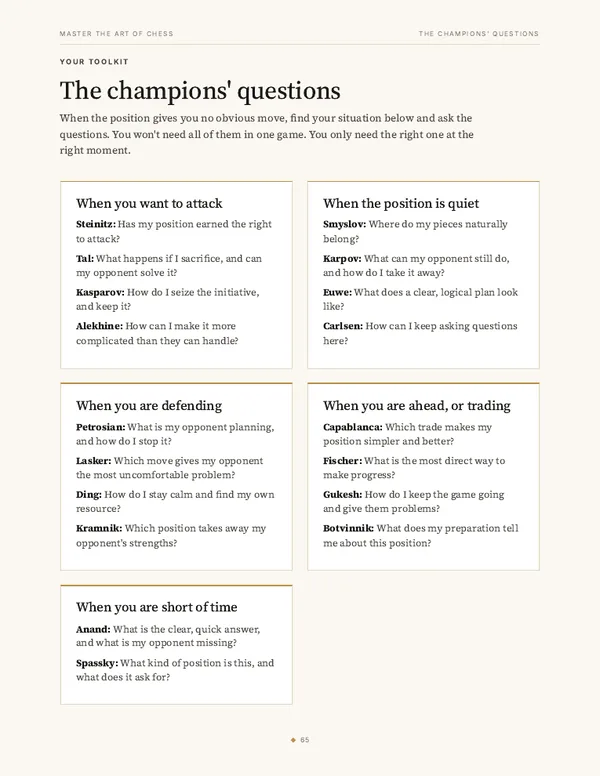
Every champion gets a three-page chapter: how they decided, a signature position where it worked, where the approach goes wrong, and a drill. Here are the questions themselves, sorted by the moment you'll need them.
When you want to attack
Steinitz 1886Has my position earned the right to attack?
Tal 1960What happens if I sacrifice, and can my opponent solve it?
Kasparov 1985How do I seize the initiative, and keep it?
Alekhine 1927How can I make it more complicated than they can handle?
When the position is quiet
Smyslov 1957Where do my pieces naturally belong?
Karpov 1975What can my opponent still do, and how do I take it away?
Euwe 1935What does a clear, logical plan look like?
Carlsen 2013How can I keep asking questions here?
When you're defending
Petrosian 1963What is my opponent planning, and how do I stop it?
Lasker 1894Which move gives my opponent the most uncomfortable problem?
Ding 2023How do I stay calm and find my own resource?
Kramnik 2000Which position takes away my opponent's strengths?
When you're ahead, or trading
Capablanca 1921Which trade makes my position simpler and better?
Fischer 1972What is the most direct way to make progress?
Gukesh 2024How do I keep the game going and give them problems?
Botvinnik 1948What does my preparation tell me about this position?
When you're short of time
Anand 2007What is the clear, quick answer, and what is my opponent missing?
Spassky 1969What kind of position is this, and what does it ask for?
How the two books work together
One book teaches the judgment. The other checks whether it stuck.
Reading makes an idea feel obvious. An unlabelled position shows whether you can actually see it at the board.
1
Read
How one champion decided: the question, a real game, and a drill.
2
Decide
Face a real position with no hint. Choose your move and write down why.
3
Compare
See what was played and the reason. Keep one pattern for your own games.
Book I · Read · 70 pages · New edition
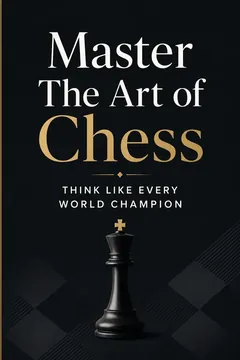
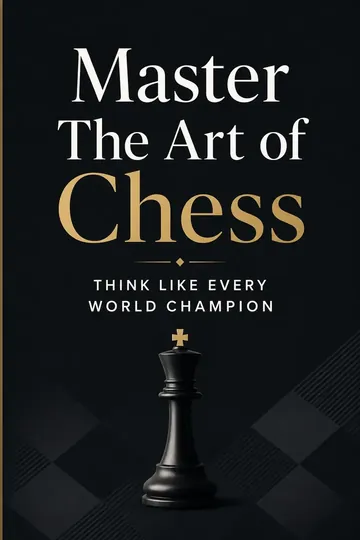
Master the Art of Chess
How all 18 world champions made decisions, from Steinitz to Gukesh, with real photographs and real games.
18 three-page champion chapters
18 signature positions, each checked with Stockfish
What to steal, where it goes wrong, and a drill
A 30-day plan and a study log
Book II · Decide · 88 pages
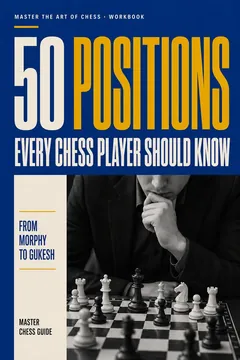
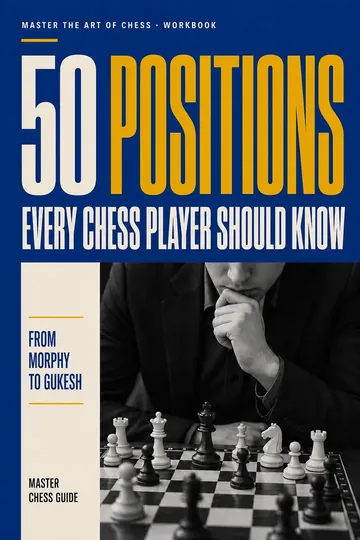
50 Positions Every Chess Player Should Know
Fifty critical moments from Morphy in 1858 to Gukesh in 2024. Nothing tells you whether to attack, defend, trade or wait.
50 full-page positions from real games
Tactics, attack, strategy, defense and endgames, mixed
Solutions in a separate section, so nothing is spoiled
A FEN for every position, a scorecard and a pattern review
Look inside
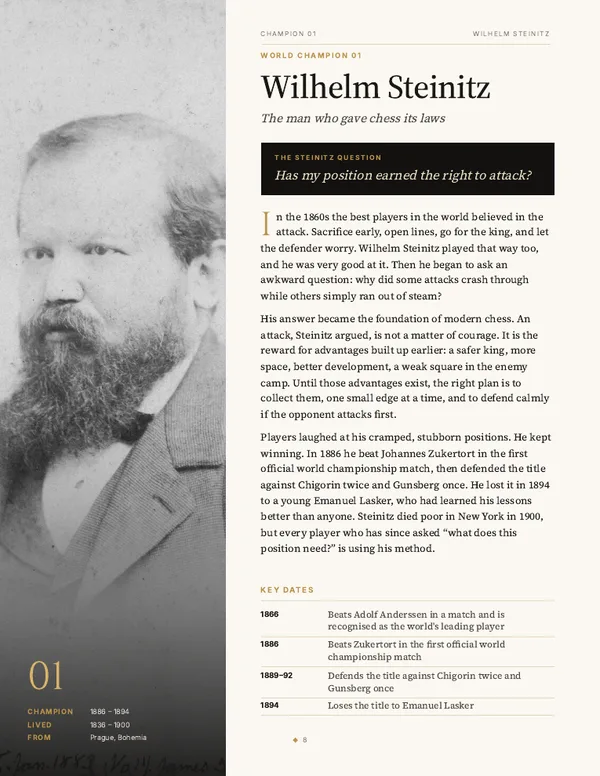
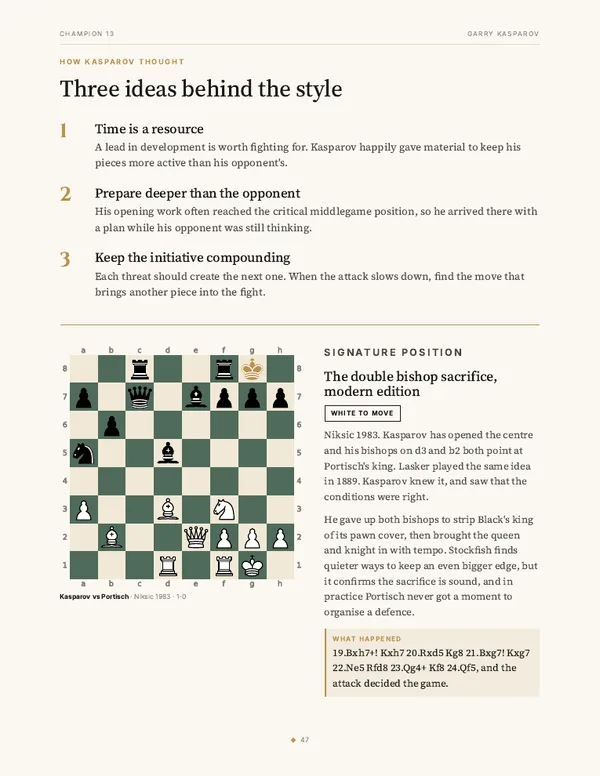
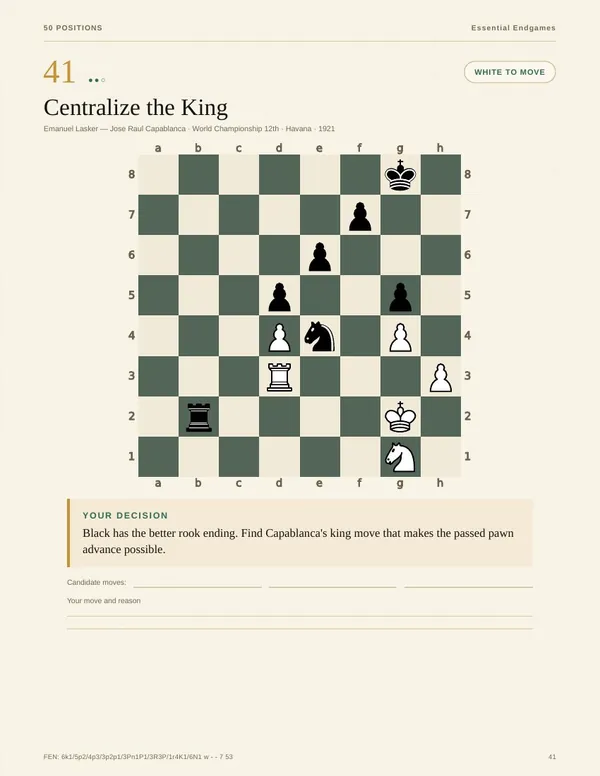
Chapter opener: SteinitzIdeas and signature position: KasparovThe champions' questions
A full-page exerciseAn endgame studySolutions and lessons
Pricing
Both books for $26. Or start with one.
One payment, instant PDF download, no subscription.
Not quite. If you know how the pieces move and have played real games, you can use both books. If you're still learning the rules, start there first.
I'm rated 1500+. Is this too basic?
No. Intermediate players usually know plenty of chess and still struggle to choose between several reasonable moves. That choice is exactly what the two books train.
Do I need a board or an engine?
No. Both PDFs read on any device. A board or a chess app helps when you calculate, and every workbook position comes with a FEN so you can set it up in seconds.
Should I get the guide, the workbook, or both?
If you're unsure, get both. The guide gives you the ideas and the workbook shows whether you can spot them without a hint. Together they're $26 instead of $34.
How is the Champions series different?
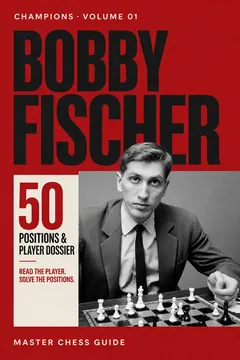
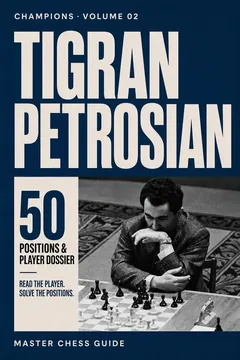
The guide covers all 18 champions in breadth. Each Champions volume goes deep on one player: a full dossier plus 50 positions from his own games.
How do I get the books?
Polar delivers the PDF downloads as soon as your payment clears. There's nothing to ship and nothing to subscribe to.
What if it's not for me?
Email within 30 days for a full refund.
Your next game will leave theory around move 12. Have a question ready.
Eighteen champions' questions and fifty positions to practice them on. Two PDFs, delivered instantly, with a 30-day refund.